


Aviator Bet Payout System Explained for Players in Eswatini
Aviator is a crash-style casino game built around a simple question: when will you cash out? A plane climbs across the screen while a multiplier rises. At an unpredictable point, the flight ends. A player who has cashed out before that moment receives a payout based on the multiplier reached; a player who has not loses the stake. The format is easy to understand, but the payout mechanics and risks deserve a closer look—especially for players in Eswatini deciding whether to try it online.
This guide explains how a bet turns into a return, what auto-play and auto-cashout do, and why no strategy can reliably predict the next flight. Game availability, payment methods and legal requirements depend on the operator and the player’s location. Check those details before depositing. To find the game or related information, visit https://sz-aviator-game.com/.
How an Aviator round works
Each round begins with a new flight. Players place a stake before the round starts, then watch the multiplier increase from its starting point. It might stop early or continue much higher; the exact result is not known to players in advance; To secure a return, a player must cash out while the flight is still active.
The core calculation is straightforward: gross payout = stake × cash-out multiplier. For example, if a player stakes E10 and successfully cashes out at 2.00×, the gross payout is E20. That includes the original E10 stake, so the net profit is E10. If the round ends before the player cashes out, the stake is lost and the payout is zero.
Displayed values, currency options and minimum or maximum stakes can vary by casino. A game may show amounts in a currency other than lilangeni, or the operator may convert deposits and withdrawals. Always check the currency and conversion terms shown in the cashier before playing.
Understanding the payout system
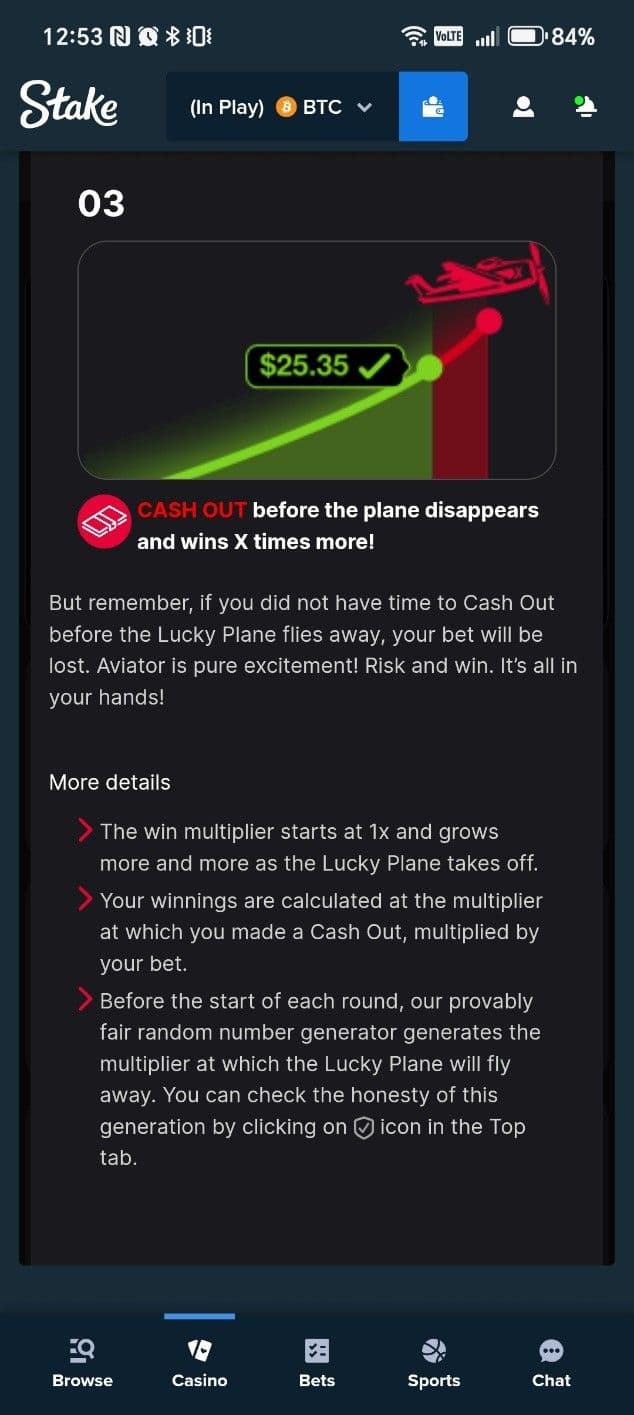
Cash out before the flight ends
A successful cash-out locks in the multiplier shown at that moment, subject to the game’s rules and any network or platform delay. Aiming for a larger multiplier can produce a larger gross payout, but it also means staying in the round longer and risking that the flight ends first. A low target may be reached more often in some game histories, yet that does not make it a guaranteed way to profit.
Suppose the stake is E5 and the player exits at 1.50×: the gross payout is E7.50 and the net gain is E2.50. If they hold out for 5.00× but the flight stops at 3.20×, the result is no payout. The game does not pay the missed 3.20× value after the round has ended.
Manual and automatic cash-out
Manual cash-out lets the player tap or click while the multiplier is rising. It offers direct control, but requires attention and can be affected by device performance, connection quality and the platform’s processing. Auto-cashout allows a player to set a target multiplier in advance. If the round reaches that target while the feature is active, the game attempts to cash out automatically.
Auto-cashout can reduce the chance of forgetting to exit, but it does not guarantee a win. If the flight ends below the chosen target, the stake is lost just as it would be with a manual bet. Check that the target is correctly entered before a round begins, and understand whether the game supports two bets with separate cash-out targets.
What the multiplier does—and does not—tell you
The multiplier tells you how much a successful cash-out would return relative to the stake. It does not show how likely the next multiplier is to reach that point. Previous rounds can be interesting to review, but a sequence of low or high results does not establish what the next round will do. In games using independent random outcomes, each round is separate; a pattern on the history panel is not a dependable prediction.
Players may encounter a history list, a fairness information page or a provably fair verification feature. These tools can help explain how past results are recorded or checked, depending on the implementation. They do not reveal the next result. Read the game’s help section to learn what verification is available, and do not treat any unofficial prediction tool as proof of a coming multiplier.
Practical tips for managing a session
- Set a fixed budget. Decide how much you can afford to lose before opening the game, and do not borrow or use money meant for essentials.
- Choose a stop point. Set a time limit and a loss limit. Stop when either is reached rather than trying to win back losses.
- Use small test stakes. If you are learning the interface, begin with the minimum permitted amount and confirm how cash-out works.
- Do not chase a target; A large multiplier is possible, but holding out for it can also result in losing the entire stake.
- Take breaks. Rapid rounds can make it easy to lose track of time and spending. Step away if you feel pressured or frustrated.
These are money-management practices, not winning strategies. No betting pattern can remove the uncertainty of the round or ensure a profit. If gambling stops feeling recreational, use any available account limits or self-exclusion tools and seek local support.
Bonuses and promotional terms
A casino may advertise a welcome offer, free bets or other promotions alongside Aviator. A bonus is not automatically cash you can withdraw. Terms may include wagering requirements, eligible games, expiry dates, maximum bet limits and withdrawal restrictions. Some promotions may exclude particular games or contribute differently toward wagering.
For players in Eswatini, check the operator’s terms and conditions and confirm that the promotion is available in your location. Never deposit more than planned just to qualify for a bonus. If a cashier, support representative or promotion page gives inconsistent information, ask the operator for clarification before accepting the offer.
Checking a casino before depositing
Aviator’s payout rules describe the game, but the casino controls the account, deposits and withdrawals. Before registering, look for clear information about the operator’s identity, licensing, age restrictions, complaint process and responsible-gambling tools. Confirm that the service is permitted for you to use from Eswatini and that the payment methods shown are genuinely available to local customers.
Read withdrawal rules carefully: processing times, identity checks, fees, limits and exchange rates can all affect the amount you receive. Use a secure connection, protect your password and avoid sharing one-time verification codes. Do not assume that a site is trustworthy merely because it displays a familiar game logo or offers a large bonus.
Frequently asked questions
Does the payout include my original stake?
Usually, the displayed multiplier applies to the stake to show the gross payout. At 2.00× on an E10 stake, the gross return is E20 and the net profit is E10. Check the game’s own rules in case its display or terminology differs.
What happens if I do not cash out?
If the flight ends before you cash out, that bet loses and its payout is zero. A successful cash-out must happen during the active round.
Can I predict the next crash point?
No reliable method can guarantee the next result. Past multipliers and online prediction claims should not be treated as a forecast. Play only if you accept that a stake can be lost.
Is Aviator safe to play in Eswatini?
Safety depends on both the game and the casino offering it. Check the operator’s authorization and terms, use account security features, and confirm local rules. The game itself does not make every website carrying it legitimate or suitable.
Can I win real money?
Some casinos offer real-money play, but availability and withdrawal conditions depend on the operator and local requirements. Winning is never guaranteed, and losses can exceed any short-term gains. Review all terms before risking money.
Bottom line
Aviator’s payout system is simple mathematically: a successful exit multiplies the stake by the cash-out value, while a flight that ends before cash-out pays nothing. The challenge is not calculating a return—it is accepting that the exit window and final multiplier are uncertain. Eswatini players should verify the casino, local availability, currency and withdrawal terms before playing, set firm limits, and regard every stake as money they may lose.

Leave a Reply